

 Vasundhara Sanger
Mumbai: After the monsoon each year, scores of poor folks from the tribal-dominated villages in the Palghar district of Maharashtra, about 100 km from Mumbai, migrate to the ‘Maximum City’ and its suburbs to work as labourers, where they live in the overcrowded and poorly-serviced slums or make-shift facilities—the only dwellings they can afford in their meagre earnings.
“Did anybody pause to think why are they here in the first place?” Asks Ramesh Narayan, an award-winning advertising veteran who, after having led numerous successful global campaigns, is now channelling his expertise into social impact, engaging with integrated rural development programmes.
“Nobody wants to live in slums devoid of basic facilities like water and sanitation, but we give them a choice through our Integrated Rural Development Programme,” he continues, eager to showcase the initiative, which, for him, goes beyond what he says is mere “tokenism”.
Narayan, who opted for an early retirement from work, actively engaged in what he calls the Integrated Village Development Project in Palghar about four years ago after being invited to inaugurate a project. “I have spent half my life doing social things. So, I thought about effecting a complete transformation of the lives of the tribal villagers,” utters the seasoned professional who founded Canco Advertising and built a remarkable career marked by creative excellence and strategic vision.
What delighted Narayan was that it was the landmark 40th village of Chandragav, nestled on the hilly slopes of Palghar, which saw the light of the day under the integrated rural programme, and all this was achieved in less than five years.
Supported by the Rotary Club of Bombay and Chirag Rural Development Foundation, the 40th village project was completed on February 13 this year. The occasion was even more special because it was Ramesh Narayan’s beloved mother, Seetha Narayan’s birth anniversary, and there could not have been a better way to honour her memory. In addition to the Narayan family, the financial support came from Indian Oxides and Chemicals Ltd. The villagers also contributed their bit with Shram Daan (volunteer for labour work).
Although Maharashtra has declared itself 100 percent electrified, the state provides single-phase electricity that can only run a light and fan, but not a pump. Hence, the thrust towards solar energy.
Push for solar energy
It is well known that the National Solar Mission is a significant initiative of the Government of India and State Governments to promote ecologically sustainable growth while addressing India’s energy security challenge.
In this context, and keeping in mind the government of India’s various schemes to encourage the generation of solar power in the country (like The PM Surya Ghar: Muft Bijli Yojana, launched in 2024), it is noteworthy that the integrated village development project in Palghar has focussed on the inclusion of solar energy.
Narayan also emphasises the project’s focus on sustainability, in which solar energy plays a crucial part. “There is a backup solar lamp for every home, and solar-powered street lights ensure safety from scorpion and snake bites,” informs Narayan. This commitment to solar energy is a key part of the project’s strategy for improving the village’s living conditions, safety, education and sustainability.
Solar energy’s key role is to provide continuous light to villagers through individual solar lamps, powering irrigation systems for year-round water access, and ensuring safe drinking water with solar-powered water filters. It also enhances safety with solar-powered street lights and supports engaged learning in schools and Anganwadis by providing continuous power for smart TVs and other educational tools.
In a nutshell, solar energy has improved the village’s living conditions, safety, education and sustainability.
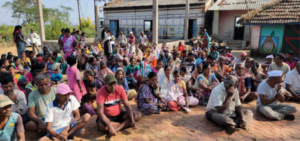
Overall Impact of the Integrated Village Development Project
Electricity and Lighting: Continuous light for 723 villagers with individual solar lamps and 23 solar-powered street lights, enhancing safety and reducing fears of snake and scorpion bites.
Water Access: Year-round access to irrigation water for 15 farming families, cultivation of more than 15 acres of land, and provision of 2500 litres of drinking water per day with individual water filters for safe drinking water.
Education: Improved learning environments for 40 primary school children (including 22 girls) and 52 Anganwadi children (including 28 girls) through smart TVs and continuous solar power.
Agricultural Support: Training sessions for farmers on best practices, provision of seeds, and fruit-bearing saplings to optimise yield.
Sustainability: Overall transformation of 13088 lives across 40 villages, solarisation of 35 educational facilities, irrigation of 360 acres of land, installation of 140 solar street lights, and provision of 50,000 litres of safe drinking water, all powered by 229KW of clean solar energy.
These efforts collectively contribute to improved living conditions, enhanced safety, better educational opportunities, and sustainable agricultural practices, thereby mitigating urban migration.
With its transformative power, the initiative aims to mitigate urban migration and improve rural life using solar energy, enhancing educational facilities, providing irrigation, and ensuring safe drinking water for thousands of lives across 40 villages.
The good work continues, and another project will be inaugurated on February 16 in Bhoyepada, Wanipada, and Gavthan with support from Sumitomo Chemical India Ltd.
“This is just a drop in the ocean, but it is a beginning,” concludes Narayan.


