
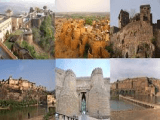
The Unesco accorded the World Heritage tag to as many as six majestic hill forts in the desert state of Rajasthan, including the Amber Fort in Jaipur, taking the total number of properties with this recognition in the state to eight. The serial site includes the forts of Amber, Chittaurgarh, Kumbhalgarh, Ranthambore, Jaisalmer and Gagron in districts of Jaipur, Chittaurgarh, Rajsamand, SawaiMadhopur, Jaisalmer and Jhalawar respectively.
Considering the forts in different locations as a serial site, the World Heritage Committee at its 37th meeting held in the Cambodian capital of Phnom Penh has inscribed these forts on the World Heritage List, state tourism minister Bina Kak told reporters. "It is a matter for pride for Rajasthan and for the country as a whole. We worked hard to make the nomination of the forts best possible. "These forts will now receive enhanced international recognition the way the Jantar Mantar in Jaipur did after being selected in the World Heritage List in 2010," she said. "The selection will also pave way for other monuments to be nominated for being included in the World Heritage tag.
"In fact, the work relating to Stepwells of Abhaneri, Bandikui, Bundi as well as the Fresco paintings of the Shekhawati region for being submitted for consideration to the Unesco list has already started," the minister said. The state now has total eight properties (six forts, one national park and one observatory) with the Unesco world site status, Kak highlighted.
The serial site of historic forts having eclectic architecture, some up to 20 km in circumference, bears testimony to the power of the Rajput princely states that flourished in the region. The forts use the natural defences offered by the landscape like hills, deserts, rivers, and dense forests.
Enclosed within defensive walls are major urban centres, palaces, trading centres and other buildings including temples that often predate the fortifications within which developed an elaborate courtly culture that supported learning, music and the arts. Some of the urban centres in the forts have survived, as have many of the site's temples and other sacred buildings. The forts also feature extensive water harvesting structures, largely still in use today.
The Keoladeo National Park in Bharatpur, which is home to a large numbersof aquatic migratory birds during the winter, was the state’s first site to get the Unesco status in 1985 and it was followed by the celebratory astronomical observatory in Jaipur, the Jantar-Mantar, which was inscribed on the list in 2010.